Like many people I have, over the years, enjoyed collecting different types of memorabilia. During my youth I amassed (and still have) an impressive collection of baseball cards. Years later I made a brief attempt at collecting coins, but was never able to enjoy that collection as much as my baseball cards. And since then, nothing has been able to excite my interest in collecting the way baseball cards captured my youth.
That is until now. Over the past few years I have established a new collection that I enjoy even more than my childhood baseball card collection: historical flags! As a student of history, I have always enjoyed looking at how different events of the past were captured and brought to life by their participants, and the creation of flags is one of those fundamental symbols that help to encapsulate and internalize the past into the subconsciousness of later generations. As years pass, however, the important meanings behind these various flags (and the past they were meant to symbolize) are lost or often distorted, reducing the former glory of these banners to nothing more than mere cloth.
It is for these reasons that I have decided to share my love of historical flags and the history they represent. It is my hope that those who read this blog (or who might come across it in a Google search) will gain an appreciation for what these flags were meant to represent. After all, they can tell us a great deal about our nation's complex and fascinating heritage.
So, without further delay, I give you Part I in my new series, Flags of our Fathers Today's installment: the Gadsden Flag.
The Gadsden (Don't Tread on Me) Flag has played a unique role over the course of the past 200+ years. For a number of reasons, the flag has been a favorite for many generations of Americans, who have adopted the flag's coiled rattlesnake and inspiring words to fit their respective agendas. The yellow banner has been found on the masts of early revolutionary naval boats, at the vanguard of Civil War regiments and in the hands of common citizens, who find patriotic purpose in those four simple words: "Don't Tread on Me".
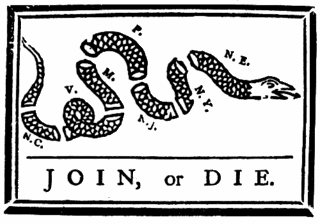
The origins of the Gadsden Flag are interesting to say the least. As I have pointed out in a previous post, early America's fascination with the rattlesnake is quite extensive. Benjamin Franklin's "Join or Die" political cartoon had effectively woven the rattlesnake obsession into the ongoing and ever-changing political discourse of the time. As a result, the image of the rattlesnake was incorporated into a plethora of different political broadsides, posters and yes, even flags.
In 1775, as war between Britain and her colonies became an inevitable reality, the Second Continental Congress authorized the creation of five companies of marines to accompany the naval forces that were already preparing to confront the British. These marines carried with them yellow-painted drums with the image of the coiled rattlesnake and the motto "Don't Tread on Me". This was the first recorded occasion of the rattlesnake and motto being used together. As one "anonymous" writer (later identified as Benjamin Franklin) stated to the Pennsylvania Journal in December of 1775:
I observed on one of the drums belonging to the marines now raising, there was painted a Rattle-Snake, with this modest motto under it, 'Don't tread on me.' As I know it is the custom to have some device on the arms of every country, I supposed this may have been intended for the arms of America.
[...]
I confess I was wholly at a loss what to make of the rattles, till I went back and counted them and found them just thirteen, exactly the number of the Colonies united in America; and I recollected too that this was the only part of the Snake which increased in numbers.
[...]
'Tis curious and amazing to observe how distinct and independent of each other the rattles of this animal are, and yet how firmly they are united together, so as never to be separated but by breaking them to pieces. One of those rattles singly, is incapable of producing sound, but the ringing of thirteen together, is sufficient to alarm the boldest man living.
It didn't take long for this image to catch on. While attending the Second Continental Congress, Colonel Christopher Gadsden (you guessed it, this is the guy whose name is associated with this flag), who was one of the commanding officers of the naval/marine venture, presented several delegates with his prototype for a flag that was to be flown on the mainmasts of their naval ships. From the South Carolina Congressional journals:
Col. Gadsden presented to the Congress an elegant standard, such as is to be used by the commander in chief of the American navy; being a yellow field, with a lively representation of a rattle-snake in the middle in the attitude of going to strike and these words underneath, "Don't Tread on Me!"
The Flag was an immediate success. In the early years of the Revolution, the infant Marines and Navy both flew the Gadsden Flag as their unofficial banner. And though eventually replaced by other more meaningful banners (i.e. the Betsy Ross Flag), the image of the coiled rattlesnake and its accompanying "Don't Tread on Me" motto remained popular and were included in later flags.
As for Christopher Gadsden, his story is one of those forgotten but incredible tales of bravery and duty. Gadsden rose to prominence during the French and Indian War, climbing to the rank of Captain. During the Revolution, Gadsden was a part of the Stamp Act Congress, First and Second Continental Congress, and was one of the founders of the Sons of Liberty in his native South Carolina. He was also elected to the position of Lt. Governor and helped to draft the state's constitution.
Gadsden also served with great distinction during the Revolution, climbing all the way to the rank of General. Gadsden was also a prisoner of war, and the tale of his time as such is a remarkable tale of bravery and defiance. From Wiki:
When the British laid siege to Charleston in 1780, John Rutledge, as president of the council fled to North Carolina to ensure a "government in exile" should the city fall. Gadsden remained, along with Governor Rawlins Lowndes. General Benjamin Lincoln surrendered the Continental Army garrison on May 12 to General Sir Henry Clinton. At the same time, Gadsden represented the civil government and surrendered the city. He was sent on parole to his Charleston house.
After General Sir Henry Clinton returned to New York, the new British commander in the South, General Cornwallis changed the rules. On the morning of August 27, he arrested about 20 of the civil officers then on parole. They were marched as prisoners to a ship and taken to St. Augustine, Florida. When they arrived, Governor Tonyn offered the freedom of the town if they would give their parole. Most accepted, but Gadsden refused claiming that the British had already violated one parole, and he could not give his word to a false system. As a result, he spent the next 42 weeks in solitary confinement in a prison room at the old Spanish fortress of Castillo de San Marcos. When they were finally released in 1781, they were sent by merchant ship to Philadelphia. Once there, Gadsden learned of the defeat of Cornwallis at Cowpens and withdrawal to Yorktown. He hurried home, to help the restoration of South Carolina's civil government.
As you can see, the Gadsden Flag represents much more than a simple rattlesnake. It embodies the spirit of the man whose name the flag carries, not to mention those early Navy and Marine soldiers who hoisted the yellow banner high on their mainmasts. Their defiance and stubbornness in the name of liberty stands as a greater monument than any flag could hope to capture. But perhaps those four simple words do aptly describe their zeal for independence:
In 1754, Philadelphia printer Benjamin Franklin became one of the earliest political cartoonists in American history. As a printer, Franklin had regularly published political commentaries on various issues. His "Join or Die" publication, however, was uniquely different and would be remembered for generations to come.
During the early part of 1754, Franklin became gravely concerned about the security and future of the British colonies. As war between Britain and France loomed on the horizon, Franklin believed that colonial unity was becoming increasingly important. In Franklin's mind, each individual colony was going too far in its own direction, and thus neglecting the greater needs of the American colonies as a whole. As a result, Franklin created his "Join or Die" cartoon to serve as an appeal for unity. The cartoon (originally done as a wood carving) was posted not only in Franklin's paper, but was distributed across the colonies. The snake (each section representing an individual British colony), was purposely cut into pieces, suggesting that death would come not only to the snake, but to the colonies as well if they chose to stay divided. (It is also worth noting that 18th century society believed that a snake would come back to life if its pieces were all put together and buried before sundown).
During the French and Indian War, Franklin's "Join or Die" slogan was used as a battle cry, inspiring colonies to unite against the French. In the years prior to the American Revolution, Franklin would again use his "Join or Die" logo to promote union with the British (Franklin even suggested to Parliament that the colonies could be joined with Great Britain in the original Acts of Union, which had united Scotland and England). England's passage of the Stamp Act in 1765 gave Americans a cause to rally around. Naturally, Franklin's slogan was brought out of the closet, this time to rally against the British.
With the onset of the American Revolution, patriots from across the colonies used Franklin's "Join or Die" cartoon to promote the cause of independence. The slogan could regularly be seen in the windows of shops, on flags, and in newspapers.
Years later, Northerners would again resurrect Franklin's political cartoon to promote the cause of unity in the early years of the Civil War. There are even more recent instances of "Join or Die" being used to promote a political cause. During the 2000 presidential election, Republicans raised the banner of "Join or Die" to promote unity in the party. After President Obama's election, the "Join or Die" slogan (and the rattlesnake slogan in general) became a favorite for the Tea Party.
But why the fascination with rattlesnakes?
Early American society had a strange interest in the rattlesnake, so much that it was even considered a candidate (along with the turkey) for the national symbol of the United States. Americans loved the rattlesnake for several reasons:
1.) It was believed that the rattlesnake was indigenous to only North America. 2.) The rattlesnake has no eyelids and is therefore always vigilant. 3.) It was believed by colonists that the rattlesnake never picked a fight but also never retreated once attacked. 4.) Colonists believed that a den of rattlesnakes maintained more unity amongst its members than any other specie of animal life.
But like "E Pluribus Unum" and other early American beliefs, the rattlesnake went the way of the Dodo Bird. Much to the relief of many early American Christians, who saw the rattlesnake in the same light as the evil serpent from the Garden of Eden, the mighty American eagle soared to the top of the list and eventually became America's official symbol (much to the dismay of Benjamin Franklin, who called the eagle "a ravenous vulture of the sky."). Despite its fall from grace, the rattlesnake still maintains a popular place in American culture.
Tomorrow's post: The Gadsden "Don't Tread on Me" Flag.
Vicarious baptism -- more commonly known as baptism for the dead -- is one of the more controversial points of doctrine in the Mormon religion. For devout Mormons, this practice is seen as a holy and ultra-spiritual event, which brings salvation to the souls of the deceased. For the critic, vicarious baptism for the dead is viewed as a bizarre and secretive practice with little or no backing in traditional Christian doctrine. Yet despite the criticisms leveled against it, baptism for the dead has become a centerpiece in the religious lives of Mormon faithful.
The Mormon Church has practiced vicarious baptism since the 1840s, when their founder and prophet, Joseph Smith, revealed the doctrine to the Mormon congregation. Since then, baptisms for the dead have continued to be conducted in Mormon temples. To support the practice of vicarious baptism, Mormons will usually point out a few biblical verses from the New Testament. The first of which is Paul speaking to the Corinthians. In 1 Corinthians 15:29, Paul is quoted as saying:
Else what shall they do which are baptized for the dead, if the dead rise not at all? why are they then baptized for the dead?
In addition, Jesus' advice to Nicodemus in John 3:5 has been used to support the practice of vicarious baptism. The scripture states:
Jesus answered, Verily, verily, I say unto thee, Except a man be born of water and of the Spirit, he cannot enter into the kingdom of God.
One important factor to remember about Mormon baptisms for the dead is that the baptism DOES NOT guarantee salvation. Instead, the deceased is given the opportunity -- in the afterlife -- to accept or reject the baptism that has been performed on their behalf. In other words, the PHYSICAL act of baptism, which is believed to be required of God for salvation, is performed on Earth, while the deceased is given the chance to accept the ordinance or reject it.
In 1877, President Wilford Woodruff -- the 4th President and Prophet of the Church of Jesus Christ of Latter-Day Saints -- related the following experience that allegedly took place while he was working in the St. George Temple:
Before I left St. George, the spirits of the [Founding Fathers] gathered around me, wanting to know why we did not redeem them. Said they, “You have had the use of the Endowment House for a number of years, and yet nothing has ever been done for us. We laid the foundation of the government you now enjoy, and we never apostatized from it, but we remained true to it and were faithful to God.” These were the signers of the Declaration of Independence, and they waited on me for two days and two nights...I straightway went into the baptismal font and called upon Brother McCallister to baptize me for the signers of the Declaration of Independence, and fifty other eminent men, making one hundred in all, including John Wesley, Columbus, and others. (Wilford Woodruff, The Journal of Discourses of Brigham Young, His Counselors, and the Twelve Apostles. Vol. 19, Pp. 229).
In addition to this account, President Woodruff recalled this experience before the 1898 April General Conference of the Church:
Those men who laid the foundation of this American government and signed the Declaration of Independence were the best spirits the God of heaven could find on the face of the earth. They were choice spirits, not wicked men. General Washington and all the men that labored for the purpose were inspired of the Lord...Everyone of those men that signed the Declaration of Independence, with General Washington, called upon me, as an Apostle of the Lord Jesus Christ, in the Temple at St. George, two consecutive nights, and demanded at my hands that I should go forth and attend to the ordinances of the House of God for them.(Conference Report of the Church of Jesus Christ of Latter-day Saints. April, 1898. Pp. 89-90).
The temple work for the fifty-six signers of the Declaration of Independence and other Founding Fathers has been done. All these appeared to Wilford Woodruff when he was president of the St. George Temple. President George Washington was ordained a high priest at that time. You will also be interested to know that, according to Wilford Woodruff's journal, John Wesley, Benjamin Franklin, and Christopher Columbus were also ordained high priests at that time. When one casts doubt about the character of these noble sons of God, I believe he or she will have to answer to the God of heaven for it. Yes, with Lincoln I say: "To add brightness to the sun or glory to the name of Washington is . . . impossible. Let none attempt it. In solemn awe pronounce the name and in its deathless splendor, leave it shining on."
So, not only were the founding fathers given a vicarious baptism, but George Washington, Benjamin Franklin and others were ordained to the highest office of the Mormon priesthood. An interesting and controversial prospect to say the least
What I find so very interesting about this entire story is that it demonstrates -- on the part of the Mormon Church -- a powerful devotion to the idea that the United States was founded by the hand of God. What is even more interesting is that this ideology was not a new concept, but it began in the latter part of the 1800s, while tensions between the Mormon Church and the United States government remained hostile. This idea of American providentialism has continued to the present day for the majority of Mormons. In fact, I found it surprising that Brigham Young University has the largest ROTC program in the country. Obviously relations beteen the Mormon Church and the U.S. government have changed over the past few decades.
Every once in a while a friend will ask me to recommend to them a book on the Founding Fathers and religion. Usually they will add that they have looked long and hard for a book that is objective and avoids all of the current culture war crap that the Glenn Beck/Howard Zinn/David Barton works rely on, but have been unable to find such a book. In frustration, they express their desire for an author with historical integrity who doesn't have an agenda to portray the Founders as Democrats, Republicans, Christians, atheists, etc. In addition, they want a book that is both user friendly and free of the "deep" scholarly jargon that can be so difficult to endure. Well, I am happy to report that such a book does exist!
In his book The Faiths of the Founding Fathers, author David Holmes (who is a professor of Religious Studies and William and Mary) has created a simple, concise and informative work that explains in detail, using historical context, what the beliefs of our Founders really were. Holmes uses a simple four-point litmus test to illustrate what each individual Founder said and did on the topic of religion. His four points are:
1. Church Attendance 2. Approach to the Sacraments and Ordinances 3. Level of Church Activity and Involvement 4. The Type of Religious Language Used
Holmes states that, "An examination of history cannot capture the inner faith of any man. But in the case of the Founding Fathers of the United States, readers can use these four indicators to locate the founders on the religious spectrum with some confidence." Based on these four simple points, Holmes effectively guides the reader on a journey of understanding that relies exclusively on the history of the Founders, rather than what pop-culture tells us.
Using these four criteria, Holmes states where each of the Founding Fathers rank on the religious spectrum. First off, it is important that we recognize the role that the Enlightenment and the Great Awakening played in shaping the religious beliefs of colonial America. As Daniel Walker Howe states in his Pulitzer Prize-winning book What Hath God Wrought, religious ideology, especially Christian ideology, was very different during the colonial era than it is today.
We cannot make the mistake of viewing the belief systems of America's founding generation through the lens of modern American religion...the rise of Evangelical Protestantism, Christian conservatism and a post-modern God whose role is less intrusive than our forefathers...makes any comparison to 18th century American Christianity an impossible chore to complete without immersion in the historical context.
There are, of course, many other factors than these simple four points, which shaped the individual beliefs of our Founding Fathers. These points, however, can help us see the impact of deism and Christianity on the individual. A deist would be more likely to attend church less frequently, would strongly oppose sacraments and ordinances, would have a low level of church involvement, and would use very neutral religious language when referring to deity. An orthodox Christian, however, would be the exact opposite. With that said, let's look at one example of how Holmes' four-point litmus test can help us better understand the religion of our Founders:
George Washington: Obviously George Washington is the most popular of the Founding Fathers, and there is a great deal of religious myth that surrounds him. There is perhaps more written on the religious views of Washington than any other Founding Father. His legacy has been used by secularists and religious zealots alike, in order to shape their respective agendas. But what were his religious beliefs? Here is what Holmes states:
1.) Church Attendance: Washington, though not as devout as the typical orthodox of his day, did attend church with some regularity, and as Holmes states, “held organized religion in high regard, and was known to pray privately.”
2.) Approach to the Sacraments and Ordinances: Washington was known for regularly leaving church services before any and all sacraments. Washington strictly refused to partake in any other religious ordinances.
3.) Level of Church Activity and Involvement: Washington was a vestryman in both the Anglican and Episcopal churches, but was never confirmed in any church. Washington strongly opposed any orthodox allegiance to any one church, and remained a non-ordained, non-confirmed churchgoer.
4.) Religious Language Used: Washington’s religious vernacular was mixed with Deist and Christian phrases. Though he regularly referred to deity as “Providence” and “the Grand Architect” Washington also used the words “God” and “Christ” on a regular basis as well.
So where does Holmes rank Washington? He calls him a “Christian Deist.”
Thomas Jefferson
This one is almost too easy. Thomas Jefferson attended very little church, he never participated in sacraments and ordinances, was never ordained or confirmed (in fact he believed such practices were morally reprehensible), and his religious language was VERY common for a Deist (just look at the Declaration of Independence where Jefferson uses phrases like "Providence" and "Nature's God"). Jefferson also regularly denied the divinity of Christ, but referred to him as "the greatest philosopher." In his Bible, Jefferson even removed all references to Jesus being a savior figure.
Holmes states, and I strongly agree, that Jefferson was a non-Christian Deist. This one is pretty easy.
Benjamin Franklin Benjamin Franklin is an interesting figure. He donated a large amount of money to virtually every religion in Philadelphia and even attended most of them. Franklin, however, was never confirmed, nor did he participate in sacraments and ordinances of any church. Franklin even states in his autobiography that he denies the divinity of Jesus. Holmes also calls Franklin a Deist.
So where are the Orthodox Christians? Here is just a small list: Patrick Henry Samuel Adams John Jay Martha Washington Charles Carrol Elias Boudinot John Q. Adams
And Christian Deists? Here again is another small list that Holmes mentions: George Washington Abigail Adams Alexander Hamilton John Hancock
And here is Holmes's list of non-Christian Deists: Thomas Jefferson James Madison James Monroe John Adams Benjamin Franklin Thomas Paine
So, if you are looking for an objective, concise and fun book on the Founding Fathers and religion, I strongly recommend The Faiths of the Founding Fathers as your starting point. It will give you a firm baseline on which to begin your study of early American religion and the founding generation. I hope you enjoy it!
And The Stupidity of the Dynamic Duo is Staggering
It's been a while since I did an installment of the Glenn Beck Check. To be honest, I just get so tired of this stupid windbag that it's hard to listen to his material. Nevertheless, I will try to press on because, as of late, I have come across a lot of material that is sure to make your head spin with the stupidity and ignorance that has become a trademark of "Beckonian" idiocracy.
Over the past couple of months, Glenn Beck has been on an American rock...er..."American Revival" tour to several cities where he presents his watered-down, dumbed-up, biased, and downright false take on American history. And guess what??? He isn't alone. Like Batman needs his Robin, Glenn Beck too needs an equally stupid sidekick...and he hit a home run with his choice. Beck selected none other than David Barton, pseudo-historian extraordinaire and the most passionate voice for the "Christian Nation" crowd out there today. If you don't know anything about David Barton get ready to hold on to your hats. He'll take you on a "patriotic" "inspiring" and "religious" Founding Fathers joyride that will excite any Bible-thumping, Jesus-jamming, tea-bagging zealot that Fox News has not yet inspired. There's only one problem: almost everything he says is false. Seriously. I've been following this nut-job for a few years now. He's a demonstrable fraud who has been forced to recant his "history" on so many occasions that he has zero credibility with anyone in the historical community. Simply put, Barton is to history what creationism is to science. He's historical and intellectual poison that should be outright rejected due to his obviously biased agenda and lack of any legitimate historical backing (not to mention the fact that he simply makes crap up). The only reason he has an audience is because he tells people what they want to hear: that America is Jesusland and the founders were all die-hard Evangelical Christians. Thanks to Barton's daily radio broadcasts from his website, Wallbuilders, not to mention his numerous books including The Myth of Separation, Barton's crap has spread to the ignorant masses at virtual light speed. And now, Glenn Beck too is drinking the Barton Kool-Aid!
Here's part one of Batman and Robin's debut performance on Faux News:
Ugh! Right out of the gate Beck hits us with more of that ridiculous "socialist" "Marxist" Obama crap. Seriously, Glenn, this part of your act is getting REALLY old. And as you can see (which is a standard practice for Glenn) he never provides a single shred of evidence for this stupid rant...other than colorful crap on his blackboard (which he is usually incapable of spelling correctly).
At 1:10 into his rant, Beck brings up a topic that he regularly mentions: restoring America to its former greatness. Of course, Beck assumes that this "restoration" is somehow in harmony with his extremely messed up and biased view of American history. But let's give him the benefit of the doubt here. After all, he claims to revere the Founding Fathers (which is a good thing), but how well does he understand them? Aside from saying that "we are on the verge of collapse" what other "pearls of wisdom" does Beck have to offer?
Let's find out.
Well, the "faith," "Hope," and "charity" component sure invokes passionate feelings but it proves nothing. Perhaps Batman needs a little assistance? Enter the one and only (thank goodness there is only one of him) David Barton! At 4:10 Beck states, "here's the history you are never taught in school." Uh, yeah, totally agree there Glen...because IT ISN'T HISTORY YOU MORON!!! Let's dissect the B.S. shall we:
At 4:38 David Barton offers up one of his biggest lies of all: that congress published a Bible. Sorry but this is a complete and total lie. Here's the truth about this Bible. A Philadelphia printer by the name of Robert Aitken petitioned Congress for permission to print the Bible here in America. His hope was that he would be able to gain congressional sanctioning for his bible, especially since American printing was basically in the toilet at this time and getting books from Britain was almost impossible. Well, Aitken continued to hound Congress with a countless number of petitions asking for approval and congressional sanctioning for his bible. He never got it. What he did get, however, was a congressional endorsement of his printing. Again, American printing sucked at this time and Congress needed to get it moving. Aitken's ability to mass produce a book as large as the Bible demonstrated that American industry and independence was becoming a reality. As a result, Congress was happy to promote Aitken's printing...but NOT his Bible. And again, Congress didn't print the book, Aitken did, using his own time, resources and money. Congress never gave him a thing...except perhaps a pat on the back for his ingenuity in printing.
So how does Barton come to his conclusions? Well, the first thing he does is mess up his dates. On a number of occasions (not present in the video above) Barton tries to argue that Congress began printing these bibles in 1782, immediately following the victory of Yorktown. The problem, however, is that Aitken had already begun printing as early as 1779, a full three years BEFORE victory at Yorktown. In addition, Barton's claims that Congress "recommended" the Bible is simply Aiken's overzealous and presumptuous move to give his Bible more credit than it deserved. Congress NEVER approved it. Now, Barton claims that there are "congressional records" which show that the Bible was approved, specifically to be "A neat addition to the Holy Scriptures for use in our schools." The only problem (and he conveniently omits this part) is that these "records" are Aitken's letters to Congress! In other words, Barton's research is so bad that he actually considers Aitken's petitions as "Congressional documents." This would be like you or I petitioning Congress for a new car by stating that it would be "a neat addition to my front driveway", having Congress refuse the petition, and then using that same letter we sent as proof that Congress was for it! Barton is king of this kind of research because he knows his audience will never bother to check his sources.
At 6:50 Beck mentions Benjamin Franklin's view on religion, which were DEIST in nature (conveniently ignored by Beck). Beck recites a famous Franklin quote (from a letter to Ezra Stiles) in which Franklin states that he "believes in one God, Creator of the Universe. That He governs it by his Providence." However, Beck "conveniently" leaves out the rest of the quote. When speaking of the divinity of Jesus, Franklin wrote:
I think the System of Morals [devised by Jesus] and his Religion as he left them to us, the best the World ever saw, or is likely to see; but I apprehend it has received various corrupting Changes, and I have with most of the present Dissenters in England, some Doubts as to his Divinity.
I suppose that's just more of the "history we never learn" right, Beck?
At 7:35 Barton and Beck mention Samuel Adams and his petitions for prayer. Well, we're still doing that today (a practice that I agree with) so they should be thrilled. We're still doing something the founders did! The problem is that Beck and Barton take this thread and run it into idiocracy. Batman and Robin mention that "9 out of the 13 colonies" had state religions at the time of the founding of America. Well, duh! American COLONIES each had their own religion (or at least most of them did). However, every single state REMOVED their state religions at or shortly after the Revolution. Just another tidbit left out of their "enlightening" discussion I suppose. And of course the religion analogy has NOTHING to do with healthcare as Beck suggests. Just another stupid remark.
**If you want to read more about state religions click here for a piece I did not long ago on the controversy religion caused Massachusetts at the time of the founding**
At 8:45 David Barton mentions Charles Carroll. In the video, Barton suggests that Carroll used his wealth to establish a church in Maryland because, "there wasn't enough wealth" in the state to create one. Uh, sorry David. More half-truths and outright lies. What happened was Charles Carroll (a very devout Catholic) put up money for the establishment of a Catholic church in the area because the religion was being forced out. Though established to be a haven for Catholics, Maryland Evangelical Christians (the same Christians that David Barton supports) grew sick of their presence and wanted them out. As a result, Catholics were severely chastened by early Americans. Carroll was simply trying to help out his own, not assist religion in a broad sense, and certainly not to create government-sanctioned religion
Of course Beck's final comment is priceless: "Why we are bringing this up America is because you have to have the correct history." LOLOLOLOLOLOLOLOLOLOLOLOL! Speak for yourself, Glenn. The rest of us are doing just fine!
And here's part 2 of Batman and Robin's act:
Right out of the gate Barton brings up the book, The Godless Constitution. This book is exactly what it claims to be: an examination of the godless nature of American society. And no, it is NOT used that much as a textbook like Beck suggests. And though I agree with Beck and Barton that this book is every bit the nonsense (from the far left) as is Beck and Barton's crap (from the far right), I do wish Barton would point out where in the Constitution we can find even one reference to God. Guess what...it doesn't exist! But again, this is inconvenient to Barton and Beck's agenda so they don't mention the FACT that the founders intentionally drafted the Constitution to be a secular document in which references to God were intentionally left out. Yes, the book, The Godless Constitution takes this reality too far in its assumption that America is completely secular but it does at least fit this historical reality, whereas Beck and Barton are still unable to figure out what reality is.
At 1:20 Barton brings up Benjamin Rush. Now, Barton is right when he states that most Americans don't have a clue who this guy is. From what the video shows (it goes black for some reason), Barton's depiction of Rush is sound. He was a founder of the Philadelphia Bible Society and was a passionate Christian. BUT we should keep in mind that Rush's desire for Christianity to be preached in schools was rejected, so I'm not sure what Barton stands to gain by mentioning him.
At 2:08 Barton briefly mentions Stephen Hopkins. He states that Hopkins was a "devout orthodox Quaker" which isn't true. He was actually Episcopalian. And no, he did NOT use the scriptures to illustrate why America should break from Britain. Hopkins' most famous pamphlet, The Rights of the Colonies Examined was a rebuking of British taxation and had NOTHING to do with religion The Bible is only mentioned as a historical reference and is used in conjunction with Greek and Roman history (which, of course were pagan). Barton simply assumes that any reference to the Bible is conclusive proof of a person's belief in Christianity. Well, why isn't the same standard used when Hopkins references the Greeks (who are mentioned twice as much as the Bible)? Silly little tidbit of history that FOX viewers don't need I suppose.
At 2:25 Batman and Robin bring up Robert Treat Paine. Now, Barton is right in pointing out that Paine was a Chaplin...at least for a while. However, Paine eventually left the Congregationalist Church and became a devout Unitarian...you know...that "heathen" religion that rejects many of the Evangelical Christian teachings that Barton claims the founders loved.
At 4:20 Batman and Robin make the INSANE claim that the Book of Deuteronomy was the most quoted source of the founding, supposedly more so that even John Locke. HAHAHA! This one is laughable. What Barton is doing is relying on a ridiculous and bogus study done by one Donald S. Lutz, who made the incorrect assertion that the Bible (and Deuteronomy in particular) were the most quoted sources of the founding. Not so. Instead of listing all the ways that this study is utter B.S. I will simply refer you to this source, which does a more thorough job than I could ever do. Bottom line: Barton is, ONCE AGAIN, completely wrong on this matter...and Batman eats it up! Besides, it should be hysterical to one and all when they hear Batman and Robin talk about the Law of Moses being a foundation for American republicanism. I mean, who out there would want to return to the Law of Moses? And, of course, Barton's stupid comment that it was easier to find tablets of the 10 Commandments in a government building than in a church is absurd for the very same reasons, not to mention that several of these 10 Commandments (which Batman and Robin claim are the foundation of our nation) are actually unconstitutional. Who is stupid enough to think that "Thou shalt have no other gods before me," "Remember the Sabbath day and to keep it holy," "Don't have engraven images," and "Don't commit adultery" are constitutional? Moral sure, but constitutional? Not a chance.
At 5:50 Barton completely screws up Francis Hopkinson, whom he claims was the designer of the original American flag. Not so. Though Hopkinson tried to profit from such a claim, Congress basically told him to go pound sand, due to the fact that he had zero claim to such a distinction. Barton also mentions that Hopkinson wrote a "hymn book" based on Psalms. Well, he also did one entitled, "Temple of Minerva" which is, of course, a pagan holy place.
Part 3 of the Batman and Robin fiasco:
At the beginning, Glenn Beck makes the INCREDIBLY STUPID remark that we should "fall on our knees and thank God for Fox News." Uh...I think I speak for most when I say "to HELL with FOX News." But anyway, I digress...
Ok, so Barton and Beck go off on this Thomas Jefferson/John Adams friendship. Now, it's true that Rush claimed to have had a dream in which he saw Jefferson and Adams become friends again after their long political feud (a beautiful story) but...
Barton is COMPLETELY AND TOTALLY misrepresenting the John Adams letter. Again I will defer to Chris Rodda who does a much better debunking of this crap than I could. Click here to see it. Rodda reveals just how big of a liar Barton is.
At 3:30 we get to see Beck's overly-inflated sense of self when he compares himself and his role to that of the founders. SPARE US, Batman! And then Robin chimes in by saying that 17 founders lost everything they owned, 4 lost wives 5 prisoner of war, etc., etc. etc. Well, all he needed to do was go to Snopes to see that most of those claims are the stuff of legend. Click here to see for yourself.
At 6:15 you hear Batman thank Robin for being on the Texas school board. Well, we can thank Barton for getting Thomas Jefferson removed from the curriculum. INCREDIBLY stupid thing to do.
At 7:00 Barton tries to say that George Washington was a Christian. Conveniently, Barton forgets to mention the fact that Washington never took communion, refused to pray on his knees, and never made any formal claims to any one religion. Speaking personally, the religion of Washington (and Jefferson) are of particular interest. If you really want to have a breakdown of what Washington believed click here. And for Jefferson click here. Don't accept that "progressives" (Beck's favorite scary word) were somehow involved in a conspiracy to re-write American history. If you believe that, chances are you believe in Loch Ness Monster, Bigfoot and the alien spaceship at Roswell.
Part 4 of the stupid fest:
Ok, this one REALLY pisses me off because Jefferson is my favorite founder. Jefferson DID NOT sign any document with, "In the Year of our Lord, Christ, nor did he create a church or have the Marine band play Christian hymns. Again, here is Chris Rodda to expose Barton's crap (Click here).
Getting back to the Batman and Robin video, at 2:15 Robin mentions that Benjamin Franklin called for a prayer at the Constitutional Convention. Well, that's true, but Barton "CONVENIENTLY" forgets to mention that the prayer suggestion was unanimously rejected by the Congress. In fact, legend has it that Alexander Hamilton told Franklin that "The delegates have no need of foreign aid." And no, they DID NOT go to church! That's a total lie! Another tidbit ignored by the Dynamic Duo!
**For a breakdown of Franklin's real religious beliefs click here.**
AAAHHHH...these IDIOTS! At 4:40 they mention Jefferson's The Life and Morals of Jesus of Nazareth. This was essentially Jefferson's personal Bible. Jefferson (and Batman forgets to mention this) actually removed EVERY SINGLE miracle that Jesus ever performed. Why? BECAUSE HE DIDN'T BELIEVE THEM! Jefferson saw Jesus as a Aristotle type...not the Son of God. Barton and Beck are so stupid that they cannot pick this up...that or they don't want to tell the truth. And no, Congress didn't print this! Another lie!
In conclusion, the lies, half truths and ignorance of Glenn Beck and David Barton (Batman and Robin) gets attention for one single reason: the stupidity of the masses. If people actually took the time to see how bogus this version of history really is, they would quit giving these clowns the time of day. Perhaps Martin Luther King said it best when he declared:
"Nothing in the world is more dangerous than sincere ignorance and conscientious stupidity."
Perhaps Batman and Robin should return to the 2nd Grade???
For those of you who know me, you know that I LOATHE political parties. I cannot stand how some people are so willing to align themselves to one particular political ideology as if it is the sole guardian of all truth, justice and the American way. What I loathe more than political parties, however, are political pundits. You know, these "shock jock" talk radio and television personalities that have created a WWE style of entertainment by intertwining politics with apocalyptic doomsday prophecies and other emotionally-triggered nonsense.
Of all these political "shock jock" personalities, none disgusts me more than Glenn Beck. Now don't get me wrong here, I do not hate Glenn Beck the man nor do I disapprove of his conservative leanings. On some issues I agree with Beck 100%. What bugs me so much about Beck's radio and television programs are two things: first his almost complete reliance on apocalyptic, "doomsday" rhetoric, and second, his near complete historical illiteracy. Whether it's his bizarre rants on Thomas Paine, Theodore Roosevelt or Woodrow Wilson, or his strange description of the "evolution" of progressivism, Beck has -- time and time again -- demonstrated his woeful ignorance of American history. Now, only one of two possibilities are true: either Beck really is that historically illiterate or he is preying on the illiteracy of his audience. Either way it isn't a good thing.
Anyway, I have decided to install a new running series on my blog that will attempt to correct some of the "Beckisms" that are floating around out there on the internet. Now, I don't want people to think that I exclusively loathe Beck. On the contrary. No matter who the political "shock jock" is (Rush Limbaugh, Sean Hannity, Keith Olbermann, Rachel Maddow, Bill Maher, NealBoortz, etc.) I believe they are all in the business of one thing: RATINGS! These people are NOT the guardians of true American patriotism, nor are they the exclusive gatekeepers of truth, justice and the American way. Instead, as I have stated before, they are the "WWE wrestlers" of politics. Nothing more.
But in this arena of WWE politics, it is Glenn Beck that is the "Hulk Hogan" of the ring. As a result -- and because of his many ridiculous and incorrect rants -- I have chosen to single him out. It has nothing to do with his party or political leanings but exclusively due to his incorrect and misleading material. In fact, I believe that many Republicans/Conservatives (and I know many personally) are annoyed with Beck and would like to see him either go away or tone it down. So, without further delay, here is my first installment to the "Glenn Beck Check:"
On November 25th, Beck gave his "Thanksgiving Special" on Fox News:
Ok, sounds pretty typical of Beck. The video is filled with heart-warming rhetoric that makes you feel warm and fuzzy inside, right?
Well, it's also ridden with quite a few historical errors. Let's point a few out shall we:
1.) Thanksgiving DID NOT begin on Clark Island. Beck is simply trying to give a pretty story (and yes, it is a beautiful story) of how some of the "pilgrims" on the Mayflower survived almost being shipwrecked. However, this WAS NOT the "first Thanksgiving." William Bradford, one of the original "Pilgrims" makes it clear in his account that the so-called first Thanksgiving was held during the Autumn of 1621...NOT 1620 like Beck states.
2.) Beck starts off by referring to the Massachusetts Constitution of 1780. And while it is true that the Mass. Constitution did state that it "was the duty" of its citizens to recognize God, Beck conveniently ignores the part which states that "No law shall be passed prohibiting the free exercise of religion." In other words, a CLEAR guarantee of religious freedom (a.k.a. a SEPARATION of church and state). This is an important point because, for whatever reason, many pundits like Beck succumb to the stupid notion that a separation of church and state will somehow eliminate religion from American society entirely. This couldn't be further from the truth. As James Madison pointed out:
The purpose of separation of church and state is to keep forever from these shores the ceaseless strife that has soaked the soil of Europe with blood for centuries.
Believing that religion is a matter which lies solely between man and his God, that he owes account to none other for his faith or his worship, that the legislative powers of government reach actions only, and not opinions, I contemplate with sovereign reverence that act of the whole American people which declared that their Legislature should "make no law respecting an establishment of religion, or prohibiting the free exercise thereof," thus building a wall of separation between Church and State. (Letter to Danbury Baptists, 1802).
For the Founding Fathers, the idea of a separation between church and state was THE ONLY way of maintaining religious freedom for all. Apparently this lesson is a little to hard for Beck to grasp.
3.) Next, Beck points to the Washington Monument, but he forgets that construction on the monument didn't even begin until 1832, thus the founders had NOTHING to do with it.
4.) Beck keeps pushing this "Moses" thing throughout the video. His reason for doing so it to somehow show that America's destiny is tied to Biblical prophecy, or that the founders clung to Biblical teachings. In reality, Beck is grasping at straws. Take for example the following picture of the statue atop the Supreme Court Building in Washington D.C.:
At first glance, this elegant statue of Moses standing guard over the Judicial Branch of America's republic seems to support what Beck is saying. But this is only half the truth. A closer look will also reveal that Moses is accompanied by a statue of Confucius (the great Chinese philosopher) and Solon (the great Athenian poet, statesman and leader in early Greece). Inside the Supreme Court building you are also likely to see the pagan statues of Britannia and Mars. Often referred to as the "Temple of Justice," the Supreme Court building illustrates that the founders were fond of ALL ancient civilizations. Their incorporation of Roman, Greek and Egyptian ideas are NOT evidence of their exclusive love for Moses and the Bible, but instead of their interest in all ancient civilizations and ideas.
Now, Beck is right when he points out that Benjamin Franklin suggested a national symbol/emblem of Moses and the fire separating Pharaoh's chariots, but this was in reference to the impending war with Britain, and Franklin thought the comparison of the small Israelites being liberated by the hand of God from the mighty British...er...Egyptians appropriate (it's also worth nothing that the suggestion was soundly defeated by almost everyone).
5.) Perhaps the strangest of Beck's faux pas are his references to Thomas Jefferson. Sorry Glenn, but you'd be hard pressed to find a more staunch supporter of church/state separation than Jefferson. But don't believe me, here's what Jefferson said on the matter:
"I consider the government of the U S. as interdicted by the Constitution from intermeddling with religious institutions, their doctrines, discipline, or exercises. This results not only from the provision that no law shall be made respecting the establishment, or free exercise, of religion, but from that also which reserves to the states the powers not delegated to the U.S. Certainly no power to prescribe any religious exercise, or to assume authority in religious discipline, has been delegated to the general government."
"Millions of innocent men, women and children, since the introduction of Christianity, have been burnt, tortured, fined and imprisoned; yet we have not advanced one inch towards uniformity." -Thomas Jefferson, Notes on Virginia, 1782
"History, I believe, furnishes no example of a priest-ridden people maintaining a free civil government. This marks the lowest grade of ignorance of which their civil as well as religious leaders will always avail themselves for their own purposes." -Thomas Jefferson to Alexander von Humboldt, Dec. 6, 1813.
"Christianity neither is, nor ever was a part of the common law." -Thomas Jefferson, letter to Dr. Thomas Cooper, February 10, 1814
Hmmmmm....sounds like a clear separation of church and state to me! But hey, he's Glenn Beck! He CAN'T be wrong because he's the TRUE voice of patriotism, justice and the American way, right?
Our Founding Fathers have become icons of American culture. You see their monuments all across this nation's landscape. In Washington D.C., South Dakota, Virginia and other locations, our founders are immortalized in marble and stone. Even the very money we use every day pays homage to several of these important heroes. Though each of these various monuments have their own unique story, I want to focus on the one that is perhaps the most overlooked: our dollar bill.
The dollar bill has a tremendous amount of symbolism and history to it. Chances are that your average dollar bill looks like the one above -- unless you have one of the new ones. The format for this type of dollar bill was created in 1957, and has been the longest standing design in American history. The paper money that comes to us from the various mints across the nation is, in reality, hardly paper. The average dollar bill -- and other bills for that matter-- is actually a linen/cotton/silk blend, which has proven to stand the test of time. Just think about how long a dollar bill can actually last. Pretty incredible for a piece of "paper." The various blue, red, and green fibers make it tremendously hard to duplicate. Even the type of ink used for our money goes through a rigorous process.
Origins of the Dollar Bill Symbols: During the Second Continental Congress, the delegates commissioned a seven man committee -- which included Benjamin Franklin -- to come up with a national seal, emblem and motto. The committee began its work in 1776, but quickly came to a screeching halt, since the delegates were unable to agree on anything. The only thing that came out of the committee was an idea for the all-seeing eye hovering above a pyramid. Many people today believe this to be the result of masonic influence. The only problem with that theory is that the committee members did not come up with the idea of the Pyramid. In fact, the idea of the pyramid came from Charles Thomson and William Barton, who were both experts in Egyptian history. Thompson and Barton submitted this proposal to the committee, which was unanimously accepted. They also came up with the idea of the eye hovering unattached over the pyramid, to signify that America's quest was not complete (If you look closely at the eye, you will see that it is actually the eye of George Washington on the front side of the dollar bill). One of the most interesting symbols that Thomson and Barton created is that the western side of the Pyramid is shaded. This was to be symbolic of the fact that the western half of America was yet to be explored. The eye was a symbol for God's ever watchful presence. The phrase "Annuit Coeptis (above the pyramid) means "He [God] has favored our undertaking." A close look at the base of the pyramid will show several Roman numerals (MDCCLXXVI) which gives us the number 1776, the year of American independence. The phrase "Novus Ordo Seclorum" means "New Order of the Ages." All of these symbols were finally accepted on June 20, 1782 and were later incorporated onto our money in 1935.
Due to the fact that the committee was only able to come up with the all-seeing eye is important to note, because it signifies that our emblem is not entirely inspired by the Founding Fathers, and that it was CERTAINLY not inspired by masonic beliefs. Both Thomson and Barton were never a part of the Freemasons, and gained their inspiration purely from their love of Egyptian history. This is important because the early American republic took many pieces of Roman, Egyptian and Greek civilization and incorporated it into our nations culture (one look at Washington D.C. proves this point. The capital building is very Roman in structure, and the Washington Monument is an Egyptian Obelisk).
The image of the bald eagle has also become synonymous in our day with American virtue. It is present on virtually every national monument and national cemetery. For most, the eagle is the undisputed symbol of American independence. Our Founding Fathers, however, had a completely different interpretation. The early Founders -- including Franklin, Jefferson and Washington -- were against the idea of an eagle as the national symbol. Franklin actually wanted the rattlesnake to be used as the national symbol. Franklin believed that a rattlesnake was unique only to America, and that they were an eternally vigilant animal -- because rattlesnakes have no eyelids. Many scientists of the 18th century believed that the Rattlesnake never slept, making it even more vigilant. Franklin even suggested that the Rattlesnake never strikes unless attacked, signifying America's will to avoid conflict unless attacked first. It was also believed that the Rattlesnake could be brought back to life if it was cut up and its pieces assembled and buried before midnight (a strange 18th century belief). Franklin believed this was significant because it appealed to the unity of the States -- he used this analogy in his earliest political cartoon "Join or Die". Franklin hated the eagle, calling it "a despicable vulture of the sky." In fact, the Rattlesnake had a lot of significance for the founding generation. It was present on several flags, including the first Naval Jack and the Gadsden "Don't Tread on Me" flag. After the Rattlesnake was shot down, Franklin switched to the wild turkey, claiming that it was "the most virtuous of all birds."
Many Freemasons make the claim that the eagle is actually symbolic of their influence on the founders. As they point out, the bald eagle plays an important role in several masonic rituals. If this were true, why would Franklin -- a devout member of the Masons -- be so passionately opposed to the bald eagle?
The bald eagle was later accepted, because it wears no crown, dominates the sky, and is not afraid of a storm. A closer examination of the eagle reveals that he is clutching 13 arrows and 13 olive branches. The olive branches are symbolic of America's eternal quest for peace, and the arrows are symbolic of America's readiness to fight. The phrase above the eagle "E Pluribus Unum" means "From many, one" signifying the hope for American unity. The eagle is also not holding on to the shield, which is symbolic of America's independence, and the fact that she can stand on her own. There is also a cloud of 13 stars hovering over the Eagle, which represent the 13 colonies.
For Masonic conspiracy theorists, the number 13 is supposedly significant of the founders devotion to the order. These "conspiracists" point to the fact that the number 13 appears numerous times on the back of a dollar bill. For example: -The first colonies numbered 13 -13 colonies signed on for independence -There are 13 stars above the eagle -There are 13 steps on the pyramid -There are 13 letters in the Latin phrase ANNUIT COEPTIS -There are 13 stripes on the U.S. flag and eagle's shield -There are 13 olive branches (each olive branch has 13 pieces of fruit attached to it. -There are 13 arrows
Masonic conspiracy theorists maintain that the number 13 is indicative of the devil, and that it also represents the path to a new world order. As you can see, however, there is a much simpler interpretation. The scientific principle known as Occam's Razor -- meaning All other things being equal, the simplest solution is the best -- would simply suggest that the number 13 does not represent a Masonic conspiracy, but instead represents something quite obvious...the 13 original States!
This symbol, which is on the front of the dollar bill, is significant in many ways as well. First off, the scale symbolizes the government's responsibility to maintain a balanced budget, and to be ever-responsible for the people's money. The key symbolizes the key of the treasury, which is to be always secure. There is also the masonic marking of the square, which is to signify exactness in America's finances.
Many people believe these to be masonic symbols that are somehow "magical" or "covert," and that the Founding Fathers were brainwashed by masonic teachings. In reality however, this is not all that accurate. In Colonial America it was common for people to be a part of several social clubs, and the Freemasons are just one of the many that existed in that era. For example, Benjamin Franklin started a group called the Junto, and Washington was a member of the Society of the Cincinnati. The Masons were simply another gentleman's club of the time, which proved beneficial in the post-Enlightenment era of early America. They were not a "secretive" society that had an agenda to create a new world order. They were simply another way for colonists to gather and socialize -- and get drunk!
In response to a letter from several scientists asking for Franklin to submit a scientific/scholarly work for the Royal Academy of Brussels, Franklin wrote the following:
I have perused your late mathematical Prize Question, proposed in lieu of one in Natural Philosophy, for the ensuing year, viz. "Une figure quelconque donnee, on demande dy inscrire le plus grand nombre de fois possible une autre figure plus-petite quelconque, qui est aussi donnee". I was glad to find by these following Words, "lAcadeemie a jugee que cette deecouverte, en eetendant les bornes de nos connoissances, ne seroit pas sans UTILITE", that you esteem Utility an essential Point in your Enquiries, which has not always been the case with all Academies; and I conclude therefore that you have given this Question instead of a philosophical, or as the Learned express it, a physical one, because you could not at the time think of a physical one that promisd greater_Utility.
Permit me then humbly to propose one of that sort for your consideration, and through you, if you approve it, for the serious Enquiry of learned Physicians, Chemists, &c. of this enlightened Age. It is universally well known, That in digesting our common Food, there is created or produced in the Bowels of human Creatures, a great Quantity of Wind.
That the permitting this Air to escape and mix with the Atmosphere, is usually offensive to the Company, from the fetid Smell that accompanies it.
That all well-bred People therefore, to avoid giving such Offence, forcibly restrain the Efforts of Nature to discharge that Wind.
That so retaind contrary to Nature, it not only gives frequently great present Pain, but occasions future Diseases, such as habitual Cholics, Ruptures, Tympanies, &c. often destructive of the Constitution, & sometimes of Life itself.
Were it not for the odiously offensive Smell accompanying such Escapes, polite People would probably be under no more Restraint in discharging such Wind in Company, than they are in spitting, or in blowing their Noses.
My Prize Question therefore should be, To discover some Drug wholesome & not disagreable, to be mixd with our common Food, or Sauces, that shall render the natural Discharges of Wind from our Bodies, not only inoffensive, but agreable as Perfumes.
That this is not a chimerical Project, and altogether impossible, may appear from these Considerations. That we already have some Knowledge of Means capable of Varying that Smell. He that dines on stale Flesh, especially with much Addition of Onions, shall be able to afford a Stink that no Company can tolerate; while he that has lived for some Time on Vegetables only, shall have that Breath so pure as to be insensible to the most delicate Noses; and if he can manage so as to avoid the Report, he may any where give Vent to his Griefs, unnoticed. But as there are many to whom an entire Vegetable Diet would be inconvenient, and as a little Quick-Lime thrown into a Jakes will correct the amazing Quantity of fetid Air arising from the vast Mass of putrid Matter containd in such Places, and render it rather pleasing to the Smell, who knows but that a little Powder of Lime (or some other thing equivalent) taken in our Food, or perhaps a Glass of Limewater drank at Dinner, may have the same Effect on the Air producd in and issuing from our Bowels? This is worth the Experiment. Certain it is also that we have the Power of changing by slight Means the Smell of another Discharge, that of our Water. A few Stems of Asparagus eaten, shall give our Urine a disagreable Odour; and a Pill of Turpentine no bigger than a Pea, shall bestow on it the pleasing Smell of Violets. And why should it be thought more impossible in Nature, to find Means of making a Perfume of our Wind than of our Water?
For the Encouragement of this Enquiry, (from the immortal Honour to be reasonably expected by the Inventor) let it be considered of how small Importance to Mankind, or to how small a Part of Mankind have been useful those Discoveries in Science that have heretofore made Philosophers famous. Are there twenty Men in Europe at this Day, the happier, or even the easier, for any Knowledge they have pickd out of Aristotle? What Comfort can the Vortices of Descartes give to a Man who has Whirlwinds in his Bowels! The Knowledge of Newtons mutual Attraction of the Particles of Matter, can it afford Ease to him who is rackd by their mutual Repulsion, and the cruel Distensions it occasions? The Pleasure arising to a few Philosophers, from seeing, a few Times in their Life, the Threads of Light untwisted, and separated by the Newtonian Prism into seven Colours, can it be compared with the Ease and Comfort every Man living might feel seven times a Day, by discharging freely the Wind from his Bowels? Especially if it be converted into a Perfume: For the Pleasures of one Sense being little inferior to those of another, instead of pleasing the Sight he might delight the Smell of those about him, & make Numbers happy, which to a benevolent Mind must afford infinite Satisfaction. The generous Soul, who now endeavours to find out whether the Friends he entertains like best Claret or Burgundy, Champagne or Madeira, would then enquire also whether they chose Musk or Lilly, Rose or Bergamot, and provide accordingly. And surely such a Liberty of Expressing ones Scent-iments, and pleasing one another, is of infinitely more Importance to human Happiness than that Liberty of the Press, or of abusing one another, which the English are so ready to fight & die for. -- In short, this Invention, if compleated, would be, as Bacon expresses it, bringing Philosophy home to Mens Business and Bosoms. And I cannot but conclude, that in Comparison therewith, for universal and continual UTILITY, the Science of the Philosophers above-mentioned, even with the Addition, Gentlemen, of your "Figure quelconque" and the Figures inscrib�d in it, are, all together, scarcely worth a FART-HING.
Sex scandals in government, politics and religion seem to be as American as apple pie these days. Whether it takes the form of South Carolina Governor Mark Sanford's recent escapades down to Argentina or former New York Governor Eliot Spitzer's involvement with a high-class call girl service, sexual impropriety in the halls of power is becoming quite the past time these days.
But just how new is this phenomenon?
Have no fear fellow Americans; our generation is far from being unique when it comes to sexual deviance! Let us travel back to the time of America's founding to uncover a few parallel examples of leaders involving themselves in "inappropriate" sexual practices.
First off, we have the hero of American economics, Alexander Hamilton, who became our nation's first Secretary of the Treasury. In the latter part of his time in the Washington Administration, Hamilton was involved in an affair with a a Maria Reynolds, who duped the Secretary into believing she had been left destitute and needed his help. And though there is some truth to the notion that Mrs. Reynolds was in fact an abused and battered wife, the fact remains that soon after the two became acquainted, they began a long-term affair that Hamilton was eventually forced to admit to in public. The affair ruined Hamilton's personal reputation, as well as his larger political ambitions (much to the delight of the anti-Federalists!).
Then there is the case of Thomas Jefferson, the author of the Declaration of Independence and this nation's 3rd president. As we all know, Jefferson has long been accused of having engaged in sexual relations with one of his slaves (Sally Hemmings) and even allegedly had a child with his "property." Jefferson never said anything publicly about the charges. However, in the early 1990s DNA testing on the Hemmings line revealed the strong presence of Jefferson DNA, evidence that is hard for the doubter to refute as Jefferson biographer Joseph Ellis has pointed out.
In her Pulitzer Prize-winning book, author Annette Gordon-Reed has thoroughly explored the Jefferson/Hemmings relationship, which she has described as being "a misunderstood but legitimate love affair." And while Jefferson would have certainly been condemned for having a relationship with a slave, we can only speculate as to the details surrounding their alleged union.
But the scandals don't stop there. Even the beloved Benjamin Franklin, one of America's most celebrated Founders, admitted in his autobiography to having sexual relations "with women of low character." While in England, the youthful Franklin regularly enjoyed sharing his bed with scores of prostitutes. Franklin later stated that it was a miracle he never acquired any diseases! Yes, Dr. Franklin was quite the Casanova in his day! But it didn't stop at youth. I think we all know how Franklin's life turned out so I'll just leave it at that.
And then there's the very popular but confrontational case of one West Ford, who some believe was the son of none other than George Washington. Author Linda Allen Bryant has probably done as much as anyone to force this issue upon the historical community. In her book, I Cannot Tell a Lie, Bryant argues that Washington was not only the father of a nation but also the father of a slave child. Bryant alleges that Washington began a relationship with a slave named Venus, however, it is important to point out that this entire allegation is based off of oral family history and historical speculation (for a good summary of the West Ford story click here).
There you have it! Sexual deviance is as timeless an institution as any other in this nation's proud history! Will American politicians ever learn? If history is a gauge of the future then the answer is a resounding HELL NO! We are doomed to see this pathetic cycle repeat itself soon enough. The only question I have is, who will be next?
One of my favorite books during my time in graduate school was, TheMarket Revolution: Jacksonian America, 1815-1846 by Charles Sellers. In this book, Sellers attempts to discover the roots of American capitalism by analyzing first the roots of the American subsistence and bartering economy, which was both highly localized and an extremely intimate means of tying neighbors together in a communal relationship of trust. However, Sellers argues that this communal system of economics was quickly replaced by the emergence of market capitalism during the early years of the 19th century. He writes:
By 1815 the combined influence of Federalism and entrepreneurial Republicanism had completed an essential stage of the market revolution by committing the commercial states to the political economy of capitalism (40).
As a result, the means by which goods were bought, shipped, sold etc. had been changed, catapulting the new nation into a frenzy of capitalist expansion. States like New York were quick to take advantage of this capitalist explosion. The completion of the Erie Canal for example, illustrates just how much the United States had changed in the ways in which it conducted business since the founding era. Goods were now being shipped across the nation and the Atlantic as farmers, merchants, etc. converted from their traditional bartering system by embracing a capitalist mindset to the production and sale of their goods.
Not everyone, however, was happy with this change. After all, the communal/bartering system of economics, which had literally tied neighbors and towns together in a web of mutual dependence, was being pulled out from under their feet. Scores of impoverished families who had fallen victim to the swift changes brought on by market economics sought refuge and understanding in the wake of their local disaster.
As is often the case during difficult times, these downtrodden masses sought the security and reassurance of religion to alleviate their troubles. And since the American religious landscape was already caught up in a storm of Christian revival -- i.e. the Second "Great Awakening" -- citizens did not have to look far to find a pastor that was ready and willing to hear their plea. As a result, many pastors resorted to castigating the Market Revolution as being the fruits of greed and personal selfishness. Originally spawned by the passionate late 18th century pastors like Johnathan Edwards, Samuel Hopkins and others, the "New Divinity" hoped to capture the minds and hearts of its followers by presenting a creed based on "disinterested benevolence," which shunned personal gain in favor of communal security. As Sellers states:
For intensely pressured Yankees, the New Divinity's apocalyptic utopia was an irresistible fantasy of surcease from market pressures. Amid "universal peace, love, and general and cordial friendship." Hopkins (and others) promised "no unrighteous persons" would "invade the rights and property of others." Invoking one of the subsistence culture's favorite Biblical images, he declared that "every one shall securely sit under his own vine and fig-tree, and there shall be none to make him afraid." Lawsuits, luxury, and waste would cease. There would be "such benevolence and fervent charity" that "all worldly things will be in great degree common, so as not to be withheld from any who may want them" (207).
For a people caught between the "tug-o-war" of capitalist economics and religious communal Utopianism, this division became extremely personal. As could be expected, those who reaped success from the newfound opportunities of the Market Revolution saw their personal gain as the result of hard work, dedication, and divine intervention. Those on the "losing" end of the equation, however, were quick to accept the new doctrine of communal economics that pointed the finger at emerging Market forces as being, "the Biblically predicted time of rampant discord and worldliness that would immediately precede the Millennium" (207).
Of course this cultural "back-and-forth" between personal economic gain v. the prosperity of the community was nothing new in early America. For decades, Americans had argued that the personal greed often associated with capitalism would lead to the undoing of the whole by eventually concentrating the majority of wealth into the hands of the few. Even Adam Smith, the so-called "father" of capitalism understood just how polarizing the ideals of capitalism could be on the masses when he wrote:
The necessaries of life occasion the great expense of the poor...The luxuries and vanities of life occasion the principal expense of the rich, and a magnificent house embellishes and sets off to the best advantage all the other luxuries and vanities which they possess...It is not very unreasonable that the rich should contribute to the public expense, not only in proportion to their revenue, but something more than in that proportion
In a letter to Benjamin Vaughn, Benjamin Franklin also pointed out his distrust of the elite having too much money and power in their hands. Using an analogy to prove his point, Franklin writes:
When by virtue of the first Laws Part of the Society accumulated Wealth and grew Powerful, they enacted others more severe, and would protect their Property at the Expense of Humanity. This was abusing their Powers, and commencing a Tyranny. If a Savage before he enter’d into Society had been told, Your Neighbour by this Means may become Owner of 100 Deer, but if your Brother, or your Son, or yourself, having no Deer of your own, and being hungry should kill one of them, an infamous Death must be the Consequence; he would probably have prefer’d his Liberty, and his common Right of killing any Deer, to all the Advantages of Society that might be propos’d to him.
And while the early years of American capitalism were clouded in a fog of religious and popular skepticism, it is clear that today's American capitalism has been "piggy-backed" with the belief that God sanctions capitalism above all others. When and how this transition occurred is, well, another topic for another day.
***Tomorrow's Post: What the emergence of market economics meant to the early Mormon Church.***
 Like many people I have, over the years, enjoyed collecting different types of memorabilia. During my youth I amassed (and still have) an impressive collection of baseball cards. Years later I made a brief attempt at collecting coins, but was never able to enjoy that collection as much as my baseball cards. And since then, nothing has been able to excite my interest in collecting the way baseball cards captured my youth.
 The Gadsden (Don't Tread on Me) Flag has played a unique role over the course of the past 200+ years. For a number of reasons, the flag has been a favorite for many generations of Americans, who have adopted the flag's coiled rattlesnake and inspiring words to fit their respective agendas. The yellow banner has been found on the masts of early revolutionary naval boats, at the vanguard of Civil War regiments and in the hands of common citizens, who find patriotic purpose in those four simple words: "Don't Tread on Me".